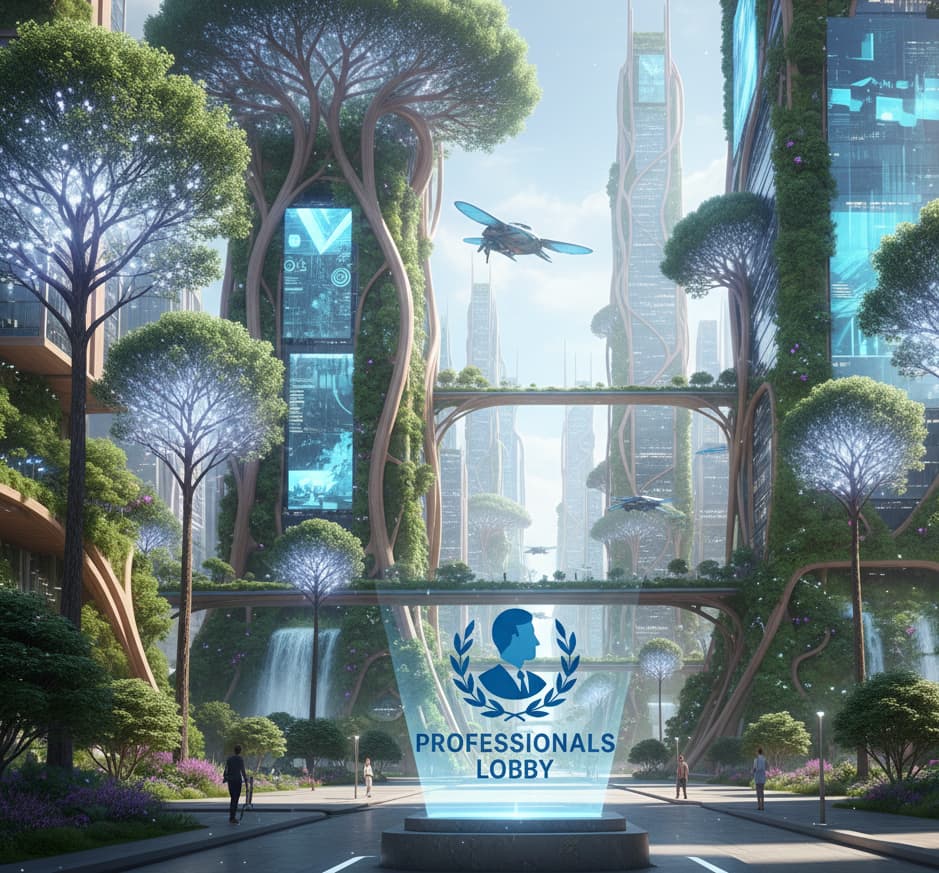
If technology were deeply aligned with nature, cities wouldn't feel like machines you live inside — they would feel like living ecosystems you belong to. This is the promise of biophilic, regenerative, and living technology: a future where intelligence works with nature, not against it.
The Core Principle
The most intelligent technology is the one that allows nature to do the hard work. This isn't a downgrade of progress — it's the next evolution of intelligence.
Journey Through This Vision
Chapter 1: Living Streetlights — When Trees Illuminate Our Paths

The Scene
You're walking home at night. Instead of harsh LED streetlights, you're guided by the soft, warm glow of trees lining the pathway. The light intensity adjusts as you approach — brighter where you need it, softer elsewhere. The air smells clean, birds nest in the branches above, and the temperature feels noticeably cooler than the concrete jungle a few blocks away.
How It Works: Nature-Meets-Technology
Bioluminescent Integration
Safe, bio-engineered algae or fungi embedded in tree bark emit natural light through biochemical reactions. No electricity needed — just natural processes.
Solar Leaf Technology
Specialized leaves absorb sunlight during the day, store energy in natural "batteries," and release it as gentle illumination at night.
Adaptive Response System
Motion sensors (disguised as seeds or bark) detect movement and adjust light levels. Animals trigger different patterns than humans.
Beyond Illumination: Multi-Layered Benefits
Environmental Healing
Each "light tree" processes 25kg of CO2 annually, reduces local temperatures by 3-5°C, and supports entire micro-ecosystems of insects and birds.
Human Wellness
Natural light patterns align with circadian rhythms, reducing urban stress. Air purification improves respiratory health by 15-20% in surrounding areas.
Economic Efficiency
Zero energy costs after installation. Maintenance is organic (pruning, occasional nutrient supplements) rather than technical repairs.
Current State & Timeline
Pilot Projects Active
Singapore's "Gardens by the Bay" uses limited bioluminescent plants. Berlin and Vancouver testing solar-integrated urban trees.
Commercial Viability
Cost parity with traditional street lighting expected. First municipal-scale contracts signed in Nordic countries.
Mainstream Adoption
30% of new urban developments globally incorporate living lighting systems as standard infrastructure.
Chapter 2: Organic Buildings — Architecture That Breathes and Heals
Traditional Approach
- Concrete-heavy construction
- Static, unchangeable structures
- Constant energy consumption
- Environmental damage during construction
- Expensive, disruptive repairs
Nature-Aligned Approach
- Grown materials (mycelium, bamboo)
- Adaptive, evolving structures
- Net-positive energy generation
- Construction that enriches environment
- Self-healing capabilities
The New Material Science
Mycelium Bricks
Grown from mushroom roots in 7 days. Stronger than concrete by weight, fire-resistant, and completely compostable at end of life.
Engineered Bamboo
Grows 1 meter per day. Processed into construction materials stronger than steel with carbon-negative footprint.
Hempcrete
Hemp fibers mixed with natural lime. Creates breathable walls that regulate humidity and temperature naturally.
Self-Healing Concrete
Embedded bacteria produce limestone when exposed to water and air, automatically repairing cracks up to 1cm wide.
Living Building Features
Breathing Walls
Living moss and plant walls that actively purify indoor air, removing 95% of VOCs and particulates.
Dynamic Facades
Building "skin" that opens/closes pores based on temperature, sunlight, and humidity — like natural organisms.
Water Intelligence
Complete water cycle within building: rainwater capture → filtration → usage → purification → release as clean water.
Edible Infrastructure
Vertical farms integrated into building surfaces providing 15-30% of residents' food needs.
Real-World Example: The Bosco Verticale, Milan
Completed 2014The "Vertical Forest" demonstrates that nature-integrated buildings aren't futuristic fantasy — they're buildable today. This pioneering project houses the equivalent of 30,000 square meters of forest on just 3,000 square meters of urban land.
Chapter 3: Living Infrastructure — Roads That Heal, Water That Thinks
The Principle: Infrastructure With Memory
Traditional infrastructure is dumb and static. Living infrastructure learns, adapts, and heals — behaving more like skin than concrete.
Intelligent Road Systems
Self-Healing Asphalt
Embedded capsules release healing agents when cracks form. Bacteria produce limestone to fill gaps, extending road life 3-5x.
Energy-Harvesting Surfaces
Piezoelectric materials convert vehicle pressure into electricity — each car generates enough to power street lighting for 30 seconds.
Permeable Pavement
Roads that absorb rainwater, reducing flood risk by 70% and naturally filtering pollutants before water reaches aquifers.
Temperature-Responsive Surfaces
Materials that lighten in summer (reflecting heat) and darken in winter (absorbing warmth), reducing urban heat island effect.
Water That Thinks
Intelligent Capture
Smart surfaces detect rainfall intensity and adjust absorption rates. Surfaces become more permeable during heavy rain.
Natural Filtration
Water passes through constructed wetlands within city blocks, removing 95% of pollutants through plant and microbial action.
Smart Storage
Underground "aquifer banks" store water based on predictive algorithms — anticipating droughts 6-12 months in advance.
Precision Distribution
AI-managed micro-irrigation delivers exact water amounts to green spaces based on real-time soil moisture and weather forecasts.
The Result
Urban Forestry as Infrastructure
Noise-Canceling Trees
Specific tree species planted in sound-wave patterns that reduce urban noise by 10-15 decibels — equivalent to double-glazed windows across entire districts.
Pollution-Mapping Vegetation
Plants act as natural pollution sensors. Changes in leaf color or growth patterns provide real-time air quality data more accurately than electronic sensors.
Wind-Channeling Greenways
Strategic tree placement creates natural ventilation corridors, reducing HVAC energy needs by 25% in surrounding buildings.
Chapter 4: Quiet Technology — Intelligence That Observes, Not Dominates
The Paradigm Shift
Technology transitions from being the "smart" centerpiece to becoming the quiet enabler. The most intelligent systems are the ones you don't notice.
Principles of Quiet Technology
Background, Not Foreground
Technology operates like autonomic nervous systems — managing essential functions without conscious attention or interruption.
Observation Before Action
Systems learn patterns for months before making adjustments. Changes happen gradually, respecting natural rhythms.
Minimal Intervention
The ideal technological intervention is the smallest one that achieves the desired outcome, preserving natural processes.
Reversible Decisions
Where possible, technological choices can be undone or adapted without permanent consequences to the system.
AI That Thinks Like Nature
Traditional AI
- Centralized control
- Optimization for efficiency
- Rapid response required
- Single objective focus
Nature-Aligned AI
- Decentralized intelligence
- Optimization for resilience
- Patience and observation
- Multi-objective balance
Practical Applications
Forest-Inspired Traffic Management
Instead of optimizing for fastest flow (which creates bottlenecks), systems mimic forest nutrient distribution — steady, resilient flow even during disruptions.
Ant Colony Energy Grids
Energy distribution follows ant colony optimization: decentralized decision-making, multiple pathways, and dynamic rerouting around "damage."
River Flow Logic for Data
Data systems that follow river principles: natural pooling (caching), meandering paths (redundant routing), and seasonal flooding (burst capacity).
Silence as Public Infrastructure
Acoustic Zoning
AI creates "quiet corridors" through strategic tree placement and building orientation. Certain hours designated as device-free in public spaces.
Designed Soundscapes
Instead of noise pollution, cities feature intentional sound environments: water features in commercial areas, wind chimes in residential zones.
Digital Quiet Zones
Areas where wireless signals are intentionally limited, creating spaces for uninterrupted human connection and contemplation.
Chapter 5: Ecosystem Cities — When Urban Environments Learn and Adapt
The Future We're Building Toward
People won't describe these places as "smart cities." They'll say: "This city feels alive." The distinction is profound: one is technological, the other is experiential.
The Urban Ecosystem Map
Characteristics of Ecosystem Cities
Metabolic Balance
Cities measure success by ecological health indicators: air quality, biodiversity, soil health, water purity — alongside traditional economic metrics.
Circular Intelligence
Nothing is "waste" — everything is nutrient. Building materials are designed for disassembly and reuse. Organic waste becomes soil, which grows food.
Multi-Species Inclusivity
Cities accommodate non-human life intentionally. Wildlife corridors, pollinator highways, and bird-friendly architecture become standard design elements.
Seasonal Adaptation
Infrastructure changes with seasons: more shade in summer, more sunlight capture in winter, different water management in rainy vs dry periods.
New Success Metrics
Target: Air as clean as mountain regions within city centers
For every liter consumed, one liter returned cleaner to natural systems
Increase in native species compared to pre-development baselines
100% circular material flows with zero landfill contribution
Pioneering Cities Today
Singapore
"City in a Garden" initiative. 50% green cover, vertical gardens mandate for new buildings, ABC Waters program for natural water management.
Copenhagen
Carbon-neutral by 2025. Extensive green roofs, harbor swimming areas (clean enough to swim in), bicycle superhighways.
Curitiba, Brazil
Pioneer in bus rapid transit and urban parks. 52 square meters of green space per capita (4x UN recommendation).
Vancouver
Greenest City 2020 Action Plan. Zero waste goals, local food production, green building requirements.
Chapter 6: The Business Philosophy — Adaptive Intelligence in Organizations
"The same principles that make forests resilient and rivers adaptable can make organizations sustainable and innovative."
From Ecosystems to Enterprises
Forest Principle
Decentralized growth, multiple canopy layers, symbiotic relationships
Organizational Application
Distributed decision-making, multiple innovation layers, strategic partnerships
River Principle
Meandering path, pooling resources, adapting to terrain
Business Application
Flexible strategies, strategic resource allocation, market adaptation
Soil Principle
Nutrient cycling, gradual enrichment, foundation for growth
Corporate Application
Knowledge management, continuous learning, cultural development
The Nature-Aligned Decision Framework
Observe First
Before implementing any solution, spend time understanding the existing ecosystem — people, processes, relationships, and patterns.
Identify Natural Flows
Map how information, resources, and decisions naturally move through the organization. Work with these flows, not against them.
Start Small, Scale Gradually
Begin with pilot interventions. Observe results. Adjust. Expand only when the system shows readiness — like plants growing toward sunlight.
Build in Feedback Loops
Create mechanisms for continuous learning and adjustment. Systems should improve with each cycle, like ecosystems maturing over time.
Preserve Optionality
Where possible, keep decisions reversible. Avoid technological or strategic lock-ins that prevent future adaptation.
Technology Implementation Philosophy
Questions to Ask Before Implementation
- Does this technology work with our natural rhythms or against them?
- Can we start small and scale gradually?
- What existing systems will this enhance or replace?
- How reversible is this decision if circumstances change?
- Does this create flexibility or lock-in?
Common Implementation Mistakes
- Choosing technology before understanding the problem
- Implementing ERP/AI without organizational readiness
- Selecting vendors based on features rather than fit
- Scaling faster than teams can absorb
- Ignoring the human-nature-technology balance
The Professionals Lobby Approach
Neutral Guidance
We're not tied to any technology vendor. Our only interest is what works best for your organization's unique ecosystem.
Long-Term Perspective
We help you see beyond immediate pressures to consider 5-10 year implications of today's decisions.
Ecosystem Thinking
We evaluate how technology fits within your entire organizational ecosystem — people, processes, culture, and goals.
Reversibility Focus
We identify which decisions are irreversible and help you approach them with appropriate caution and planning.
Conclusion: The Next Evolution of Intelligence
The Path Forward
Progress ≠ Domination
True advancement works with natural systems, not against them. The most sophisticated intelligence understands its place within larger ecosystems.
Intelligence ≠ Complexity
The smartest solutions are often the simplest ones that leverage natural processes. Complexity should be in the design, not the user experience.
Growth ≠ Irreversible Risk
Sustainable growth preserves future options. Each decision should enhance, not limit, future possibilities.
Begin the Conversation
Whether you're planning urban infrastructure, organizational transformation, or technology implementation, the principles of nature-aligned intelligence apply. The future belongs to systems — and organizations — that learn, adapt, and evolve in harmony with their environments.