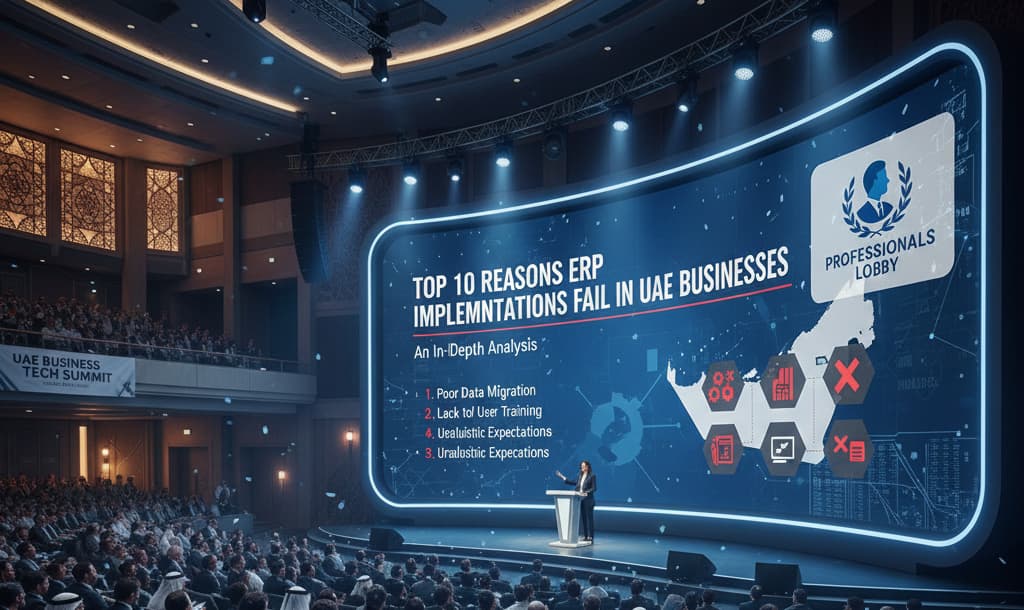
ERP implementation failures cost UAE businesses millions annually in lost productivity, budget overruns, and missed opportunities. Based on our analysis of 100+ UAE ERP projects, we've identified the 10 most common reasons for failure and how to avoid them with proven strategies from Professionals Lobby's expert consultants.
Quick Navigation
The Top 10 ERP Implementation Failure Points
Each of these failure points represents a critical risk that can derail your ERP project. Understanding them is the first step toward prevention.
Lack of Clear Requirements Definition

What Goes Wrong:
- Businesses provide vague requirements like "we need better reporting"
- Critical industry-specific features are overlooked
- Future growth needs aren't considered
- Integration requirements with existing systems are underestimated
UAE-Specific Issues:
- VAT compliance requirements not specified
- Arabic language support requirements unclear
- E-invoicing compliance needs not documented
- Local regulatory reporting ignored
Professional Solution:
Conduct a comprehensive business process analysis before vendor selection. Document 200+ detailed requirements covering all departments, regulatory needs, and future scalability. Use our ERP Requirements Checklist as a starting point.
Insufficient Executive Support & Sponsorship

What Goes Wrong:
- ERP seen as "IT project" rather than business transformation
- Lack of C-level champion to drive adoption
- Insufficient budget allocation
- Resources pulled mid-project for other priorities
Common Symptoms:
- Project committee meets irregularly
- Key decisions delayed
- Department heads not held accountable
- Budget cuts during implementation
Professional Solution:
Appoint a C-level sponsor who meets weekly with the project team. Create an ERP Steering Committee with representation from all departments. Tie ERP success to executive performance metrics.
Poor Change Management & User Adoption

What Goes Wrong:
- Employees resist new systems and processes
- Inadequate training programs
- Communication gaps create confusion
- Not addressing "what's in it for me" concerns
UAE-Specific Challenges:
- Multilingual workforce needs Arabic/English training
- Cultural resistance to new technology
- High staff turnover affecting knowledge retention
- Seasonal workforce variations
Professional Solution:
Develop a comprehensive change management plan 6 months before go-live. Identify and train super-users from each department. Provide role-based training in both English and Arabic. Use gamification to encourage adoption.
Choosing the Wrong ERP System

What Goes Wrong:
- Selecting based on price alone
- Choosing software not designed for your industry
- Over-customization to fit legacy processes
- Vendor promises not matching reality
Common Mistakes:
- Not considering UAE-specific compliance features
- Choosing global ERP without local support
- Ignoring scalability for future growth
- Selecting outdated technology platforms
Professional Solution:
Use our Industry-Specific ERP Guide to shortlist suitable systems. Conduct detailed vendor evaluations including reference checks with UAE clients. Run proof-of-concept pilots before final selection.
Unrealistic Time & Budget Expectations

What Goes Wrong:
- Underestimating implementation complexity
- Not accounting for hidden costs
- Aggressive timelines to meet arbitrary deadlines
- Cutting corners to save money
Hidden Costs Often Missed:
- Data migration and cleanup
- Custom report development
- Ongoing support and maintenance
- Training and change management
- Hardware and infrastructure upgrades
Professional Solution:
Add 20-30% buffer to initial time and budget estimates. Use phased implementation approach. Allocate separate budget for training and change management. Consider cloud ERP to reduce infrastructure costs.
Additional Critical Failure Points (6-10)
Poor Data Migration Strategy
Problem: Legacy data with duplicates, errors, and inconsistencies migrated without cleanup, causing reporting errors and process failures.
Solution: Use AI-powered data cleansing tools. Conduct multiple migration tests. Maintain legacy system access during transition.
Inadequate Testing
Problem: Skipping comprehensive testing to meet deadlines, resulting in system errors, data loss, and business disruption at go-live.
Solution: Implement 4-level testing strategy: unit, integration, user acceptance, and performance testing. Involve end-users in UAT.
Ignoring Localization Needs
Problem: Not addressing UAE-specific requirements like VAT compliance, Arabic interfaces, e-invoicing, and local regulatory reporting.
Solution: Select ERP with proven UAE compliance features. Work with local implementation partners. Test all localization features thoroughly.
Weak Implementation Partner Selection
Problem: Choosing consultants without UAE industry experience, leading to implementation delays and compliance gaps.
Solution: Vet partners thoroughly. Check UAE client references. Ensure they have certified consultants for your chosen ERP.
Lack of Post-Implementation Support
Problem: Assuming project ends at go-live, leading to unresolved issues, low user adoption, and declining system usage.
Solution: Plan for 6-12 months of hypercare support. Establish internal support team. Schedule quarterly optimization reviews.
ERP Success Prevention Framework
Based on successful UAE ERP implementations, we've developed this proven framework to avoid the common failure points:
Pre-Implementation (Months 1-3)
- Comprehensive requirements gathering
- Executive sponsorship establishment
- Vendor evaluation and selection
- Budget and timeline planning
- Change management strategy development
Implementation (Months 4-9)
- Phased rollout approach
- Regular progress reviews
- Comprehensive testing cycles
- User training programs
- Data migration execution
Go-Live & Support (Months 10-18)
- Staged go-live approach
- Hypercare support period
- Performance optimization
- User adoption monitoring
- ROI measurement
UAE ERP Implementation Case Studies
Success Story: Manufacturing Company
SAP Business OneChallenge: 40% over budget on previous ERP attempt with low user adoption
Solution: Re-started with clear requirements, executive champion, and phased approach
Results: 30% reduction in inventory costs, 25% faster month-end closing
Failure Case: Trading Company
Custom ERP SolutionChallenge: Chose low-cost solution without UAE VAT compliance
Mistake: No executive sponsor, poor vendor selection
Cost: $500K write-off + 6 months business disruption
Key Takeaways & Next Steps
Start with Requirements
Detailed requirements prevent wrong ERP selection and scope creep
Secure Executive Buy-in
C-level sponsorship is non-negotiable for ERP success
Invest in Change Management
Budget 15-20% of project cost for training and adoption
Choose Partners Wisely
Vendor and consultant selection determines project outcome
Avoid ERP Implementation Pitfalls
Our ERP consultants have helped 100+ UAE businesses implement ERP successfully. Get expert guidance to navigate the common failure points.